

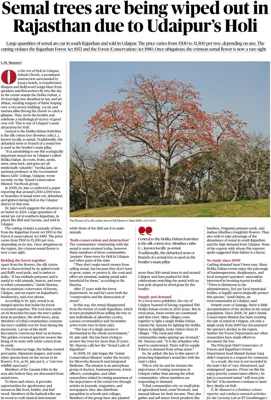
Disappearance of Semal Trees in South Rajasthan
| Aspect | Details |
|---|---|
| Why in News | Semal trees are disappearing from south Rajasthan, affecting forests and local communities. |
| Key Points | |
| - Illegal Cutting | Large quantities of semal are cut in southern Rajasthan and sold in Udaipur. |
| - Violated Laws | Rajasthan Forest Act, 1953; Forest (Conservation) Act, 1980. |
| - Ecological Importance | Integral to the forest ecosystem; supports rock bees, tribal communities, and various species. |
| - Cultural Significance | Garasia tribe believes they are descended from semal trees; used by Kathodi and Bhil tribes for crafting. |
| - Species Supported | Golden-crowned sparrow, Dysdercus bugs, Indian crested porcupine, Hanuman langurs, etc. |
| Semal Trees | |
| - Other Names | Silk cotton tree, Bombax Ceiba. |
| - Characteristics | Fast-growing, native to India; known for red flowers and cotton-like seed pods. |
| - Uses | Ornamental value; cotton used for stuffing pillows and mattresses. |
| Indian Crested Porcupine | |
| - Scientific Name | Hystrix indica |
| - Geographical Range | Southeast and central Asia, Middle East (India, Nepal, Bhutan, etc.). |
| - Behavior | Nocturnal; spends 7 hours foraging nightly; lives in caves or burrows. |
| - Predators | Large cats, wolves, hyenas, humans. |
| - Conservation Status | IUCN: Least Concern (LC); Wildlife Protection Act 1972: Schedule IV. |